If you have spent any time looking at Ayurvedic retreats or wellness programmes, you have encountered the word dosha. It appears on menus, in spa consultations, in the descriptions of treatments and protocols. What it rarely receives is a plain explanation.
This is one of Ayurveda's genuine communication problems. The concept at the centre of the system - the dosha - is actually not complicated. What it describes is something every person intuitively recognises in themselves. The language around it is just unfamiliar.
Here is the simple version, as we explain it to first-time guests at Nalanda: a dosha is a functional energy pattern. Your body and mind have a constitutional mix of these patterns that is essentially yours from birth - your prakriti, your original nature. Over the course of a life of stress, poor diet, disrupted sleep, and environmental pressures, this original balance shifts. The imbalance is what Ayurveda calls vikriti. Understanding the gap between who you naturally are and where your system currently sits is, in simple terms, what an Ayurvedic consultation is doing.
The Three Doshas
Vata
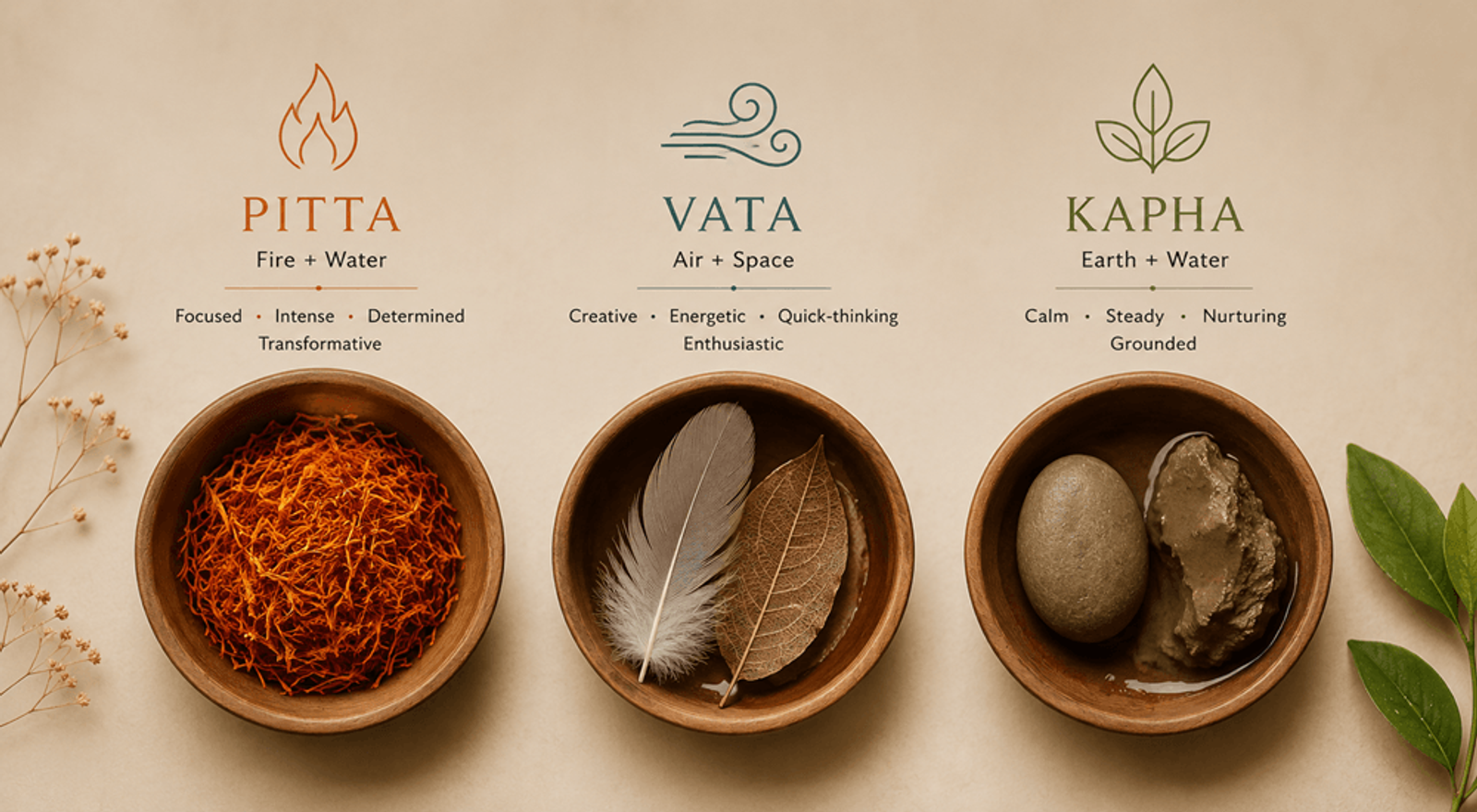
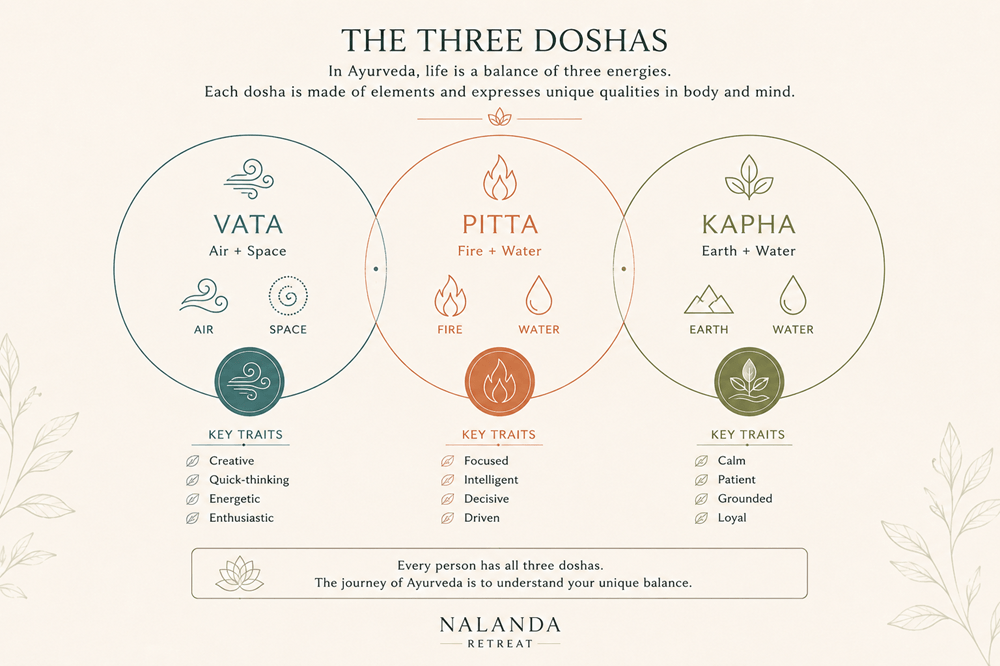
Vata is associated with air and space. It governs movement - of thought, of breath, of elimination, of circulation. People with a strong Vata constitution tend to be quick-thinking, creative, energetic, and enthusiastic. When Vata is in excess - when the movement energy is running too fast - the same person becomes anxious, scattered, unable to finish what they start, prone to constipation and insomnia and dry skin. Racing mind at 3am is, in Ayurvedic terms, a Vata disturbance.
Pitta
Pitta is associated with fire and water. It governs transformation - of food into energy, of experience into understanding, of ambition into achievement. People with strong Pitta tend to be focused, sharp, decisive, and driven. When Pitta is in excess - too much fire - the same qualities become intensity, irritability, inflammation. Skin flare-ups, digestive acidity, competitive anxiety, the inability to 'let it go' - these are Pitta disturbances.
Kapha
Kapha is associated with earth and water. It governs structure and stability - the cohesion of the body, the steadiness of the mind, the loyalty and groundedness of the personality. When Kapha is balanced, the person is warm, patient, and grounded. When Kapha is in excess - too much earth, not enough movement - that same steadiness becomes heaviness, sluggishness, difficulty initiating, holding on too long to things that no longer serve.
Most people have a primary dosha and a secondary one. Very few people are a single dosha only. And all of us have all three, in varying proportion - the question is not which dosha you have but which is dominant and which is currently out of balance.
Why This Is Useful
The reason Ayurveda uses this framework is because constitution is not one-size-fits-all. What reduces inflammation for one person may provoke it in another. What grounds a Vata constitution may stagnate a Kapha one. What brings a focused, high-achieving Pitta person back to balance is unlikely to be the same as what helps a creative, scattered Vata person feel steady.
This is why the first thing an Ayurvedic physician at Nalanda does when you arrive for a Panchakarma or Ayurvedic wellness programme is sit with you for a genuine consultation. Pulse diagnosis (Nadi Pariksha), observation, and a structured conversation about your symptoms, your sleep, your digestion, your emotional patterns - all of this builds the picture of your prakriti and your current vikriti. The programme that follows is designed for that picture, not for a generalised 'type.'
This is also why you cannot determine your dosha with any reliability from an online quiz, though many exist. The quizzes ask you to self-assess qualities that are often difficult to see clearly from inside your own experience. An experienced practitioner reads the signals you may not even know to report.
How Your Dosha Affects What You Need at a Retreat
Understanding your constitution helps you get more from a retreat experience than simply showing up with an open mind.
A Vata-dominant person coming to a retreat typically needs: grounding practices over dynamic ones, consistent routine over spontaneous scheduling, warm and nourishing food, and treatments with heavy oils that calm the nervous system. Too much variety, too much stimulation, too many new people in quick succession can be counterproductive even in a beautiful environment.
A Pitta-dominant person typically needs: cooling practices, permission to slow down and release the drive to achieve even in a retreat setting, moderate rather than intense physical challenge, and emotional space rather than intellectual stimulation. Pitta people often arrive at retreats with a plan for how to optimise the retreat. Part of the work is letting go of the plan.
A Kapha-dominant person typically benefits from: more stimulation than less, dynamic movement practices, lighter food, and social engagement rather than isolation. A retreat that is too quiet and too passive can deepen Kapha imbalance for this constitution.
This is one of the reasons that Nalanda's approach to wellness retreats does not apply a fixed protocol to every guest. The teachers and practitioners here work with who is actually in the room.
A Practical Starting Point
You do not need to know your dosha before arriving at Nalanda - the consultation will cover this. But if you want to arrive with some initial self-knowledge, notice these things in yourself over the next few days:
Sleep and waking: Do you wake easily but feel unrested (Vata)? Wake with purpose but find it hard to wind down (Pitta)? Sleep heavily and find it hard to get up (Kapha)?
Digestion: Irregular, with gas and bloating (Vata)? Sharp and efficient, with heartburn when stressed (Pitta)? Slow and steady, sometimes sluggish (Kapha)?
Response to stress: Anxiety and scattered thinking (Vata)? Frustration and controlled irritability (Pitta)? Withdrawal and heaviness (Kapha)?
Physical tendencies: Light frame, tends to dry skin and cold hands (Vata)? Medium build, warm skin, premature grey (Pitta)? Larger frame, soft skin, slow metabolism (Kapha)?
None of these are diagnoses. They are observations. Bring them to your Ayurvedic consultation at the retreat and let a practitioner build the complete picture.
Quick Answer: What is a dosha in Ayurveda?
A dosha is a constitutional energy type. Ayurveda identifies three - Vata (air and space), Pitta (fire and water), and Kapha (earth and water). Your dosha mix determines how your body and mind function optimally. When out of balance, specific symptoms arise. Ayurvedic treatment is designed around restoring that balance for your specific constitution.
To experience Ayurvedic consultation and treatment, explore our wellness programmes at https://nalandaretreat.com/programs or read about Panchakarma at https://nalandaretreat.com/what-is-panchakarma-goa/
Frequently asked questions
How do I find out what my dosha is?
The most reliable way is a consultation with a trained Ayurvedic physician who uses pulse diagnosis and observation. Online quizzes give an approximate starting point but are not clinically reliable. If you are attending an Ayurvedic programme at Nalanda, your dosha assessment is part of the arrival consultation.
Can your dosha change over time?
Your prakriti - your original constitutional nature - is essentially fixed. Your vikriti - your current state of balance or imbalance - changes constantly. Ayurvedic treatment addresses the vikriti; understanding the prakriti provides the baseline.
Is there a 'best' dosha?
No. Each dosha at balance has its gifts. Vata's creativity, Pitta's focus, Kapha's steadiness - all are valuable. The goal is not to become a different type but to return to the balance natural to your own constitution.
Why do I seem to have traits from all three doshas?
Because you do. Everyone has all three doshas; the question is proportion. Most people have one or two that are dominant. Having strong characteristics from all three is called tridoshic and is less common.
Does diet affect your dosha?
Significantly. Ayurvedic dietary guidance is built on dosha balance - some foods pacify (calm) certain doshas; others aggravate them. At Nalanda, the food at Chia Lounge and within our wellness programmes is designed with constitutional considerations in mind.
Do I need to believe in Ayurveda for it to work?
Belief is not required. The framework describes real patterns of physiology and psychology. Whether you use the Sanskrit vocabulary or not, noticing your constitutional tendencies and adjusting lifestyle, diet, and practice accordingly tends to produce measurable improvement in wellbeing.