Quick Answer
Pranayama is the formal practice of breath control in yoga. In Sanskrit, 'prana' means life force or vital energy, and 'ayama' means extension, expansion, or restraint. Pranayama techniques regulate the breath through specific patterns of inhalation, retention, and exhalation to influence physical, mental, and energetic states. It is listed as the fourth of eight limbs in Patanjali's Yoga Sutras.
The breath sits at a boundary most physiology does not reach. Heart rate, digestion, hormone release - none of those can be consciously directed in real time. The breath mostly runs on its own too, but it can be overridden. Pranayama is built on this: the breath as both a window into the nervous system and a lever for changing it.
Most people who encounter pranayama come to it through a yoga class, where it is often presented as a brief warmup or cooldown. This represents the shallowest possible introduction to a practice that has its own tradition, its own methods, and its own distinct effects. At Nalanda Retreat, pranayama is taught as a central discipline - integrated throughout the teacher training curriculum and applied therapeutically within the retreat programmes. This guide covers what pranayama actually is, the main techniques, how they work, and how a retreat context changes the experience.
Pranayama in Patanjali's Yoga Sutras
Patanjali's Yoga Sutras, the classical codification of yoga philosophy written sometime between 400 BCE and 400 CE, describe eight limbs of practice. Pranayama is the fourth, following the yamas (ethical restraints), niyamas (personal observances), and asana (physical posture).
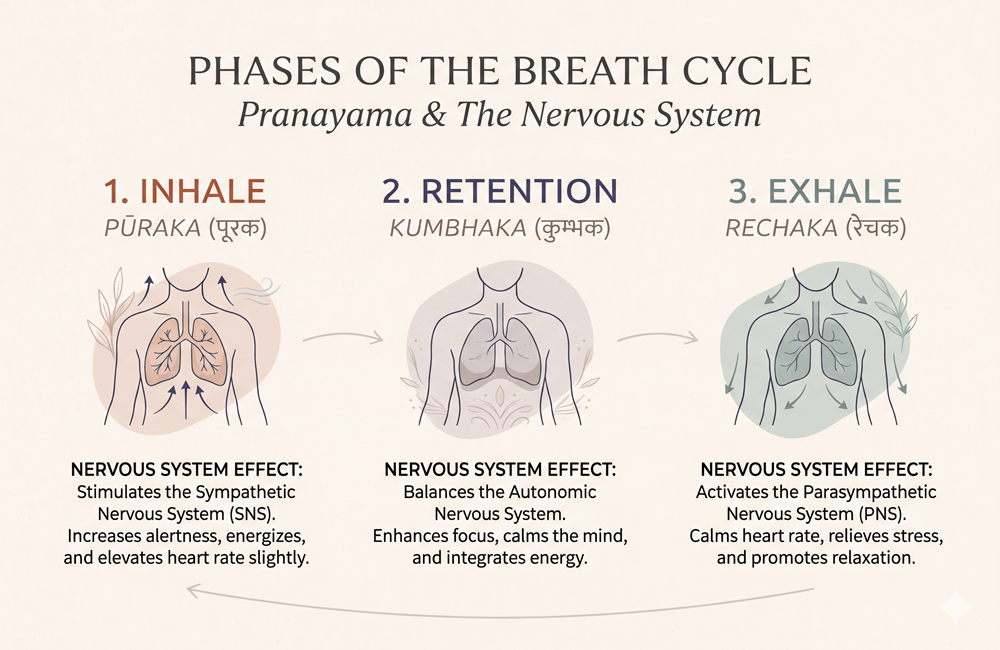
Patanjali describes pranayama as the regulation of incoming and outgoing breath. In Book II (Sadhana Pada), the Sutras describe three aspects of the practice: the external movement of breath (bahya vrtti), the internal movement (abhyantara vrtti), and the suppression of both (stambha vrtti). These correspond to the exhale, the inhale, and retention.
In the Yoga Sutras framework, pranayama is not a health practice. It is a preparation for meditation: the breath is regulated to quiet the fluctuations of the mind (chitta vrtti) so that concentration and ultimately samadhi become possible. This is a different frame from the wellness narrative that surrounds breathwork today, and understanding it helps clarify what pranayama is and what it is not.
How pranayama works: the physiology
Pranayama produces measurable effects through the autonomic nervous system. The autonomic nervous system has two divisions: the sympathetic ('fight or flight') and the parasympathetic ('rest and digest'). Most of the breath's regulatory effects work through the vagus nerve, the primary parasympathetic nerve, which connects the brainstem to the heart, lungs, and digestive organs.
Inhalation and exhalation ratios
When you inhale, heart rate increases slightly (sympathetic activation). When you exhale, heart rate decreases (parasympathetic activation). This variation is called heart rate variability (HRV). A longer exhale than inhale therefore biases the nervous system toward the parasympathetic state.
This is why pranayama techniques with extended exhales, such as Bhramari, Nadi Shodhana, or slow complete breathing, produce calming effects. It is not a belief system; it is a physiological mechanism that operates regardless of whether the practitioner knows about it. Nalanda's Sleep Restoration Programme uses these mechanisms therapeutically as part of its evening protocol.
Breath retention (Kumbhaka)
Breath retention - holding after the inhale (antara kumbhaka) or after the exhale (bahya kumbhaka) - creates a different physiological state. Carbon dioxide builds during retention, which triggers the respiratory reflex. Working with this reflex deliberately and progressively is one of the more advanced aspects of pranayama, and one that is generally taught with more caution than basic technique.
The main pranayama techniques
Nadi Shodhana (Alternate Nostril Breathing)
One of the most widely practised and researched pranayama techniques. Breath alternates between left and right nostrils using a specific finger position (Vishnu mudra). One complete cycle: inhale left, retain, exhale right, inhale right, retain, exhale left.
Effects: nervous system balancing, improved heart rate variability, reduced anxiety in research settings. The name means 'channel purification' - it is used in Ayurveda and yoga traditions to balance the ida (cooling, lunar) and pingala (heating, solar) nadis.
Kapalabhati (Breath of Fire / Skull Shining)
Active, rhythmic short exhales with passive inhales. The exhales are driven by abdominal contraction. Kapalabhati is technically a kriya (cleansing technique) rather than a pranayama, but it is taught within pranayama sequences.
Effects: energising, warming, increased alertness. Contraindicated during pregnancy, with high blood pressure, or heart conditions. Often used at the start of a pranayama session before slower techniques.
Bhramari (Humming Bee Breath)
Exhale with a humming sound while the ears are gently blocked with the thumbs or fingers. The humming creates vibration in the nasal passages and sinuses. Bhramari is used specifically within Nalanda's Sleep Restoration Programme for its strong parasympathetic effect.
Effects: strong parasympathetic activation, immediate calming effect on the nervous system. Used specifically for anxiety, stress, and pre-sleep states.
Ujjayi (Victorious Breath)
Gentle constriction of the glottis creates a soft oceanic sound on both inhale and exhale. Most commonly encountered in vinyasa yoga classes where it is used to maintain breath-movement synchronisation.
Effects: internal heat generation, nervous system regulation, auditory feedback for the practitioner's own breath. The sound gives the teacher a live reading of how the student's breath is holding up under physical demand.
Sama Vritti (Equal Breathing)
Inhale and exhale are made equal in duration, typically four counts each. Simple, balancing, suitable as an introductory technique or as a meditation preparation.
Viloma (Interrupted Breath)
Inhale or exhale is paused at intervals. For example: inhale two counts, pause, inhale two more, pause, inhale to full; then slow, even exhale. Works with the respiratory reflex to build breath capacity and nervous system tolerance.
Pranayama in a retreat context
Most yoga classes in the UK allocate five to ten minutes to pranayama, typically at the start or end of the session. This is enough for a brief practice effect, but not enough to develop skill or to experience the deeper states that extended pranayama sessions produce.
A retreat context changes this. At Nalanda, pranayama sessions are full-duration practices, typically 30-45 minutes, often structured as standalone practices rather than as bookends to an asana class. The cumulative effect of daily pranayama over a week or two weeks is qualitatively different from the effect of occasional classroom practice. This is part of why the 50-Hour Yoga Nidra and Breathwork TT at Nalanda covers pranayama as a core methodology alongside Yoga Nidra.
Several Nalanda programmes include pranayama as a core component:
- The Sleep Restoration Programme uses Bhramari, Nadi Shodhana, and complete breath techniques as part of its evening protocol
- The 50-Hour Yoga Nidra and Breathwork Teacher Training covers pranayama methodology alongside Yoga Nidra technique
- The 200-Hour Teacher Training includes pranayama as one of five curriculum areas
- Most retreat programmes include at least one dedicated pranayama session
Learning pranayama: what the progression looks like
Pranayama is taught in a sequence that builds from simple to complex. The standard progression used in most classical yoga traditions:
- Stage 1: natural breath observation, counting breath cycles, establishing breath awareness
- Stage 2: Sama Vritti (equal breathing), Ujjayi, basic Nadi Shodhana without retention
- Stage 3: Kapalabhati, Bhramari, Nadi Shodhana with short retentions, Viloma
- Stage 4: extended kumbhaka practice, Sitali and Sitkari, advanced retention ratios
Kumbhaka (retention) practice is generally introduced only after the foundation techniques are established and the practitioner's respiratory capacity has developed. Teachers with traditional training are cautious about rushing retention practice, particularly bahya kumbhaka (retention after exhale), which produces more intense effects. The 50-Hour Yoga Nidra and Breathwork TT at Nalanda addresses this progression specifically for teachers who want to teach pranayama safely.
Pranayama and Medical Conditions
Most pranayama techniques are safe for healthy adults. Kapalabhati and vigorous breathing practices should be avoided during pregnancy and with cardiovascular conditions or high blood pressure. Advanced kumbhaka (breath retention) practice is generally only taught in a teacher-supervised context. If you have a respiratory condition, heart condition, or are pregnant, consult your doctor before beginning pranayama practice.
Pranayama and Yoga Nidra: the connection
Pranayama and Yoga Nidra are complementary practices. Pranayama is typically used as a preparation for deeper meditative states, and Yoga Nidra begins where pranayama ends - in the threshold between waking and sleep. For practitioners who want to understand this connection in depth, see our beginner's guide to Yoga Nidra.
For teachers, the 50-Hour Yoga Nidra and Breathwork Teacher Training at Nalanda teaches both practices as an integrated methodology, with specific attention to sequencing pranayama before and within Yoga Nidra sessions. The breathwork retreat in Goa post covers how these practices are delivered in a retreat context.
Frequently asked questions
What is pranayama in yoga?
Pranayama is the formal practice of breath control in yoga. The word combines 'prana' (life force, vital energy) and 'ayama' (extension, expansion, restraint). Pranayama techniques regulate the breath through specific patterns of inhalation, exhalation, and retention to influence physical and mental states. It is the fourth of eight limbs in Patanjali's Yoga Sutras.
What are the main pranayama techniques?
The principal pranayama techniques are Nadi Shodhana (alternate nostril breathing), Kapalabhati (active exhale technique), Bhramari (humming bee breath), Ujjayi (victorious breath), Sama Vritti (equal breathing), and Viloma (interrupted breath). Each has specific effects and specific contraindications. Kumbhaka (breath retention) is an advanced component integrated into several of these techniques.
What does pranayama do physically?
Pranayama works primarily through the autonomic nervous system. Extended exhales activate the parasympathetic nervous system (rest and digest state) via the vagus nerve. Inhalation activates sympathetic drive (heart rate increases). Breath retention (kumbhaka) builds carbon dioxide tolerance and works with the respiratory reflex. These mechanisms are physiologically measurable and operate regardless of the practitioner's belief system.
Can I learn pranayama without a yoga teacher?
Basic techniques (Nadi Shodhana, Bhramari, Sama Vritti, Ujjayi) can be practised safely from written or video instruction. Advanced practices involving extended breath retention are generally taught in a supervised context, as the physiological effects are more intense and require gradual progression under guidance.
Is pranayama the same as breathwork?
They overlap but are not identical. 'Breathwork' is a broader category that includes modern techniques such as holotropic breathing and somatic breathwork alongside classical pranayama. Classical pranayama is the specific Indian yoga tradition of regulated breathing with roots in the Yoga Sutras and earlier Hatha yoga texts. Modern breathwork often draws on pranayama but places it within a different therapeutic framework.
How can I learn pranayama in a retreat setting?
Nalanda Retreat's programmes include pranayama throughout the curriculum. The 50-Hour Yoga Nidra and Breathwork Teacher Training is the most intensive option for practitioners or teachers who want to study pranayama systematically. The Sleep Restoration Programme uses pranayama therapeutically. Most retreat programmes include daily pranayama sessions.