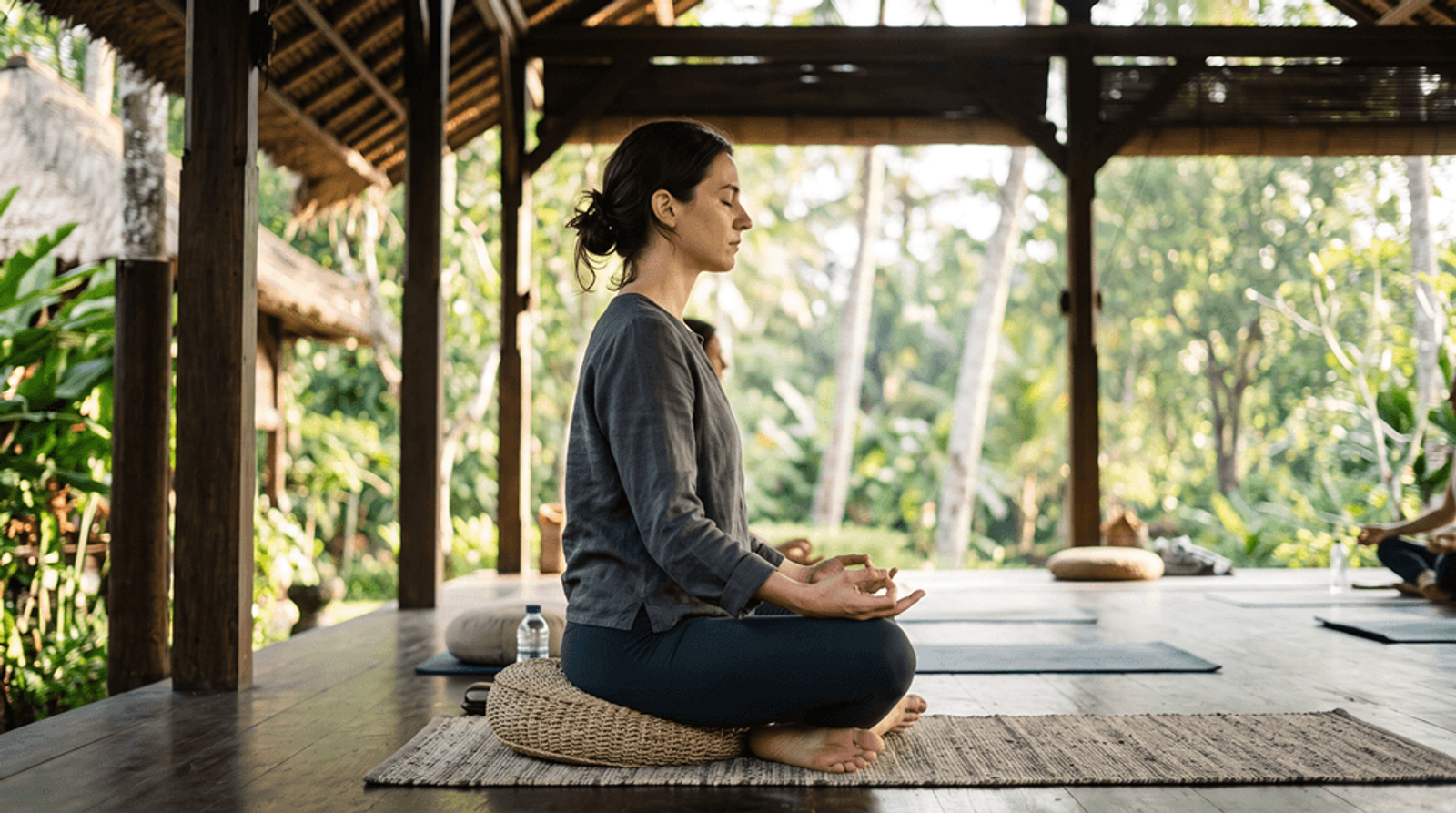
The breath is the one part of the autonomic nervous system you can control directly. Heart rate, blood pressure, cortisol release - these happen to you. The breath happens to you too, but you can also take it over. And when you do, systematically, under guidance, across multiple sessions in a supportive environment, the results reach further than most people expect.
This guide covers what breathwork actually is, what a breathwork retreat in Goa involves at Nalanda Retreat on Mandrem Beach, and why the retreat context - the environment, the sequence of sessions, the integration with Ayurveda and cold exposure - produces outcomes that a single breathwork class cannot replicate.
Direct Answer
A breathwork retreat in Goa combines structured pranayama practice, guided conscious connected breathing sessions, and supporting therapies including cold immersion and Ayurvedic treatment. At Nalanda Retreat, the Breathwork and Detox Retreat integrates daily pranayama, the Breath and Plunge ritual at Soma Cove, and a detoxification protocol. The retreat is suited to all levels. No prior breathwork experience is required.
What Breathwork Actually Is
The term breathwork is used for a range of practices. They share a common mechanism - deliberate manipulation of the breath pattern to alter physiology and consciousness - but the specific techniques, intensities, and intentions differ significantly.
Pranayama: The Classical Foundation
Pranayama is the breath regulation system developed within classical yoga. It uses specific ratios of inhalation, retention, and exhalation to produce predictable effects on the nervous system. Extended exhalation (twice the length of inhalation) reliably activates the parasympathetic branch. Breath retention after inhalation temporarily increases CO2 tolerance and stimulates the sympathetic branch in a controlled way. Alternate nostril breathing (Nadi Shodhana) is used to balance the hemispheric activity of the brain.
At Nalanda, pranayama is taught daily within the yoga programme and in dedicated Pranayama and Meditation sessions. The Tuesday and Thursday morning classes at 8am in the Beachfront Shala specifically build the pranayama foundation that the breathwork retreat draws on.
Conscious Connected Breathing
Conscious connected breathing removes the pause between inhalation and exhalation, creating a continuous circular breath pattern. This alters blood gas balance (CO2 drops, O2 increases relative to normal), which produces a specific altered state characterised by altered perception, emotional release, and physical sensations including tingling and warmth.
This form of breathwork is not appropriate without guidance and is never practised in water or in situations where loss of consciousness would create danger. At Nalanda, it is facilitated by trained practitioners in a controlled setting, with individual support throughout the session.
The Wim Hof Influence and Cold Exposure Integration
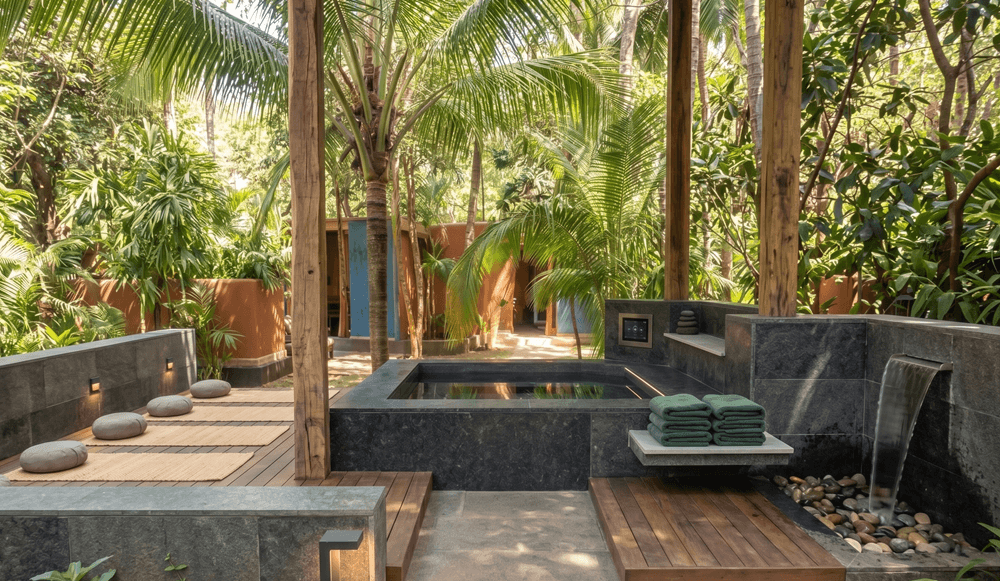
Contemporary breathwork culture has been significantly shaped by protocols combining cyclic hyperventilation with cold exposure. At Nalanda's Soma Cove, the Breath and Plunge ritual integrates breathwork with cold immersion in a designed sequence: breathwork session, cold plunge, recovery period. The physiological rationale is straightforward: breathwork raises sympathetic tone and heat shock proteins; cold immersion compounds this with a vasoconstriction-vasodilation cycle that accelerates recovery and improves systemic adaptation.
What a Breathwork Retreat at Nalanda Involves
The Daily Structure
A breathwork-focused retreat day at Nalanda begins with morning pranayama (7:00am, open-air shala). The breath foundation built in this session prepares the nervous system for the Soma Cove session later in the morning. A nourishing Ayurvedic breakfast at Chia Lounge follows, then the Soma Cove treatment block.
The Soma Cove treatment block for breathwork retreat guests typically includes the Breath Circles therapy - a structured group or individual conscious connected breathing session - followed by the Breath and Plunge ritual. The afternoon includes rest, a lighter movement session, and integration time before dinner.
The Detox Component
The Breathwork and Detox Retreat at Nalanda integrates breathwork with a naturopathic and Ayurvedic detoxification protocol. This is not a calorie-restriction detox. It is a physiological detoxification using specific Ayurvedic herbs, hydrotherapy protocols, and dietary support to support the body’s natural processes - the same mechanisms that breathwork itself activates at a cellular level.
The Infrared Sauna therapy and Contrast Hydrotherapy at Soma Cove are integrated into the detox protocol for guests who respond well to thermal stimulation. The sweat response triggered by infrared sauna exposure - specifically supporting the body’s natural elimination pathways, and it pairs directly with the breathwork mechanism of cellular oxygenation.
What the Goa Environment Adds
Breathwork in an open-air shala facing the Arabian Sea is a categorically different experience from breathwork in a studio. The air quality, the humidity, the sound of the sea - all of these change the quality of the breath before any technique begins. Mandrem Beach in North Goa provides a specific environmental baseline that supports breathwork practice in a way that indoor urban environments cannot replicate.
The monsoon season (June to September) is a particularly effective time for breathwork retreats - the humidity and freshness of the post-rain air, combined with the quiet of the off-season environment, creates conditions that experienced practitioners specifically seek out.
Who Benefits From a Breathwork Retreat in Goa
High-Output Professionals
The guest who benefits most from a breathwork retreat is typically someone whose nervous system has been in sympathetic dominance for an extended period: driven, high-performing, unable to switch off. Breathwork is one of the few tools that can reliably shift this state within a single session. A retreat gives the body multiple consecutive sessions in a supportive environment, which is when the pattern can shift.
People With Chronic Anxiety
Chronic anxiety is, in physiological terms, a pattern of respiratory dysregulation as much as a psychological state. Short, shallow breathing chronically activates the threat response. Systematic pranayama and breathwork practice - particularly the extended exhale protocols - are among the most evidence-supported non-pharmaceutical interventions for anxiety. A breathwork retreat addresses this at the level of the pattern, not just the symptom.
Those Exploring Emotional Release
Conscious connected breathing can produce emotional release - the surfacing of suppressed emotional material in a context where it can be witnessed and integrated. This is not a specific claim. It is a well-documented phenomenological report from practitioners across cultures and decades. At Nalanda, sessions involving this possibility are facilitated by trained practitioners and followed by adequate integration time.
Teacher Training: If You Want to Teach Breathwork
The 50-hour Yoga Nidra and Breathwork Teacher Training at Nalanda is the formal pathway for practitioners wanting to teach breathwork and yoga nidra professionally. It covers the Bihar School yoga nidra tradition in full and integrates contemporary breathwork facilitation methodology. The training is available as a standalone qualification or as a specialisation following a 200-hour YTT.
Frequently asked questions
Is breathwork safe?
Classical pranayama practices are safe for most people when taught by a qualified instructor. More intensive conscious connected breathing has contraindications including severe cardiovascular conditions, epilepsy, pregnancy, and recent surgery. All Nalanda breathwork sessions begin with a health intake that screens for contraindications.
What should I expect during my first breathwork session?
Common experiences during a first breathwork session include tingling in the extremities, altered perception of temperature, spontaneous emotional responses, and a deep sense of physical relaxation in the recovery period. Less common: cramping in the hands (tetany, caused by CO2 shift - harmless and brief), strong emotional release. Your facilitator will explain these possibilities before the session begins.
How many sessions does it take to notice a difference?
Most people notice a significant difference after the first session. The cumulative effect of daily practice across five to seven days is when the a meaningful shift occurs - less reactive nervous system, improved sleep, lower resting anxiety. This is why a retreat, not a single class, is the effective context.
Can I combine breathwork with Ayurvedic treatment?
Yes, and this is the structure of the Breathwork and Detox Retreat at Nalanda. The Soma Cove treatment sequence - Breath Circles, Breath and Plunge, Infrared Sauna - is designed to interact with the pranayama practice, not run in parallel with it.
How is breathwork different from meditation?
Both modulate the nervous system, but through different mechanisms. Meditation works through cognitive and attentional training. Breathwork works through direct physiological manipulation of the respiratory system, producing state changes that do not require sustained attention or prior practice to access. The Yoga Nidra guide explains a related practice that sits between the two.
Can I learn to teach breathwork at Nalanda?
Yes. The 50-hour Yoga Nidra and Breathwork Teacher Training provides formal qualification in both traditions. It is a training programme rather than a retreat, with a different pace and level of technical content.