Yoga nidra recordings are everywhere online.
A search takes you to hours of guided sessions, sleep soundtracks layered under soft-voiced instructions, apps that promise you will be asleep before the body scan finishes. Some of them are genuinely good. Many people find them useful.
And yet the guests at Nalanda who come specifically for sleep - who arrive exhausted in the specific way that goes beyond tired, the way where even a full night does not restore you - they consistently describe what happens here as different from what they had been doing at home. Not incrementally different. Categorically different.
Understanding what Yoga Nidra actually is is the first step to understanding why a Yoga Nidra retreat in India can offer a different experience from practising with a recording at home.
What Yoga Nidra Actually Is
Yoga nidra translates as 'yogic sleep' - but this is slightly misleading. The state it induces is not sleep. It is the hypnagogic threshold, the liminal place your brain passes through in the few minutes between wakefulness and sleep. You are not awake; you are not asleep; you are in a state of deep conscious relaxation in which brainwaves slow from beta to alpha to theta.
In this state, the body undergoes the same physiological restoration as deep sleep - cortisol drops, parasympathetic nervous system activation increases, the fight-or-flight pattern that keeps many people wired throughout the day begins to dissolve - but the mind remains gently conscious. You can hear the teacher's voice. You can follow a simple instruction. You do not have to do anything, which is one of the rare instructions in wellness that actually means what it says.
A 45-minute yoga nidra session is often described as equivalent to several hours of regular sleep in terms of restorative effect. This is a claim worth treating with scepticism, but it reflects something real: the theta state that yoga nidra accesses is the same state the brain is in during the most restorative phases of natural sleep, and many people - particularly those whose sleep is chronically disrupted by stress - spend very little time in it regardless of how many hours they spend in bed.
Why the Retreat Context Changes Everything
When you practise yoga nidra from a YouTube video in your bedroom, several things are working against you.
Your nervous system is calibrated to that room. You have checked your email in it, scrolled in it, worried in it. The body remembers. Even with the lights off and a recording playing, a part of you is not fully convinced this is a safe place to surrender.
You are also, in all likelihood, practising yoga nidra after a full day of stimulation - screens, decisions, social inputs, caffeine metabolising, a commute, whatever the day brought. You are asking a highly activated nervous system to drop suddenly into a theta state, which is like asking a car engine running at high revs to idle quietly by turning off the ignition.
At Nalanda, the conditions are different in a way that matters physiologically, not just atmospherically.
The day is structured to progressively reduce stimulation. Morning practice - pranayama, gentle asana - begins the deactivation. Food is warm and grounding rather than stimulating. The environment itself - Mandrem Beach, the particular quality of air from the Arabian Sea, the absence of traffic noise and blue light from screens - does not add to your load. By the time you arrive at an evening yoga nidra session, your nervous system is already partway there. The practice has less distance to travel.
This is why guests who have been practising yoga nidra at home for months sometimes report that their first session at a retreat felt like a completely different practice. It was the same technique. But the terrain was different.
You can read more about how Nalanda's Sleep Reset 48-hour programme uses yoga nidra as a central element within a wider protocol designed specifically around sleep restoration.
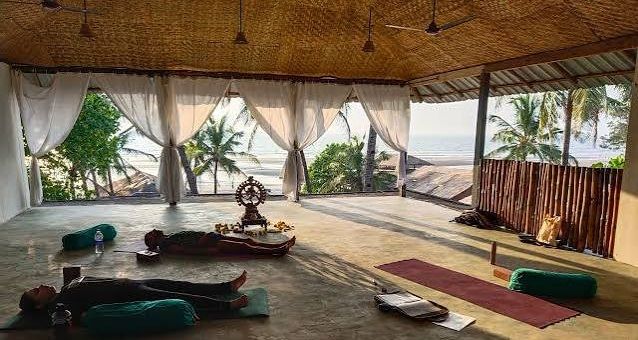
What Happens in a Yoga Nidra Session at Nalanda
Sessions typically last 45 to 60 minutes and are held in the evening, when the body's natural preparation for sleep aligns with the practice.
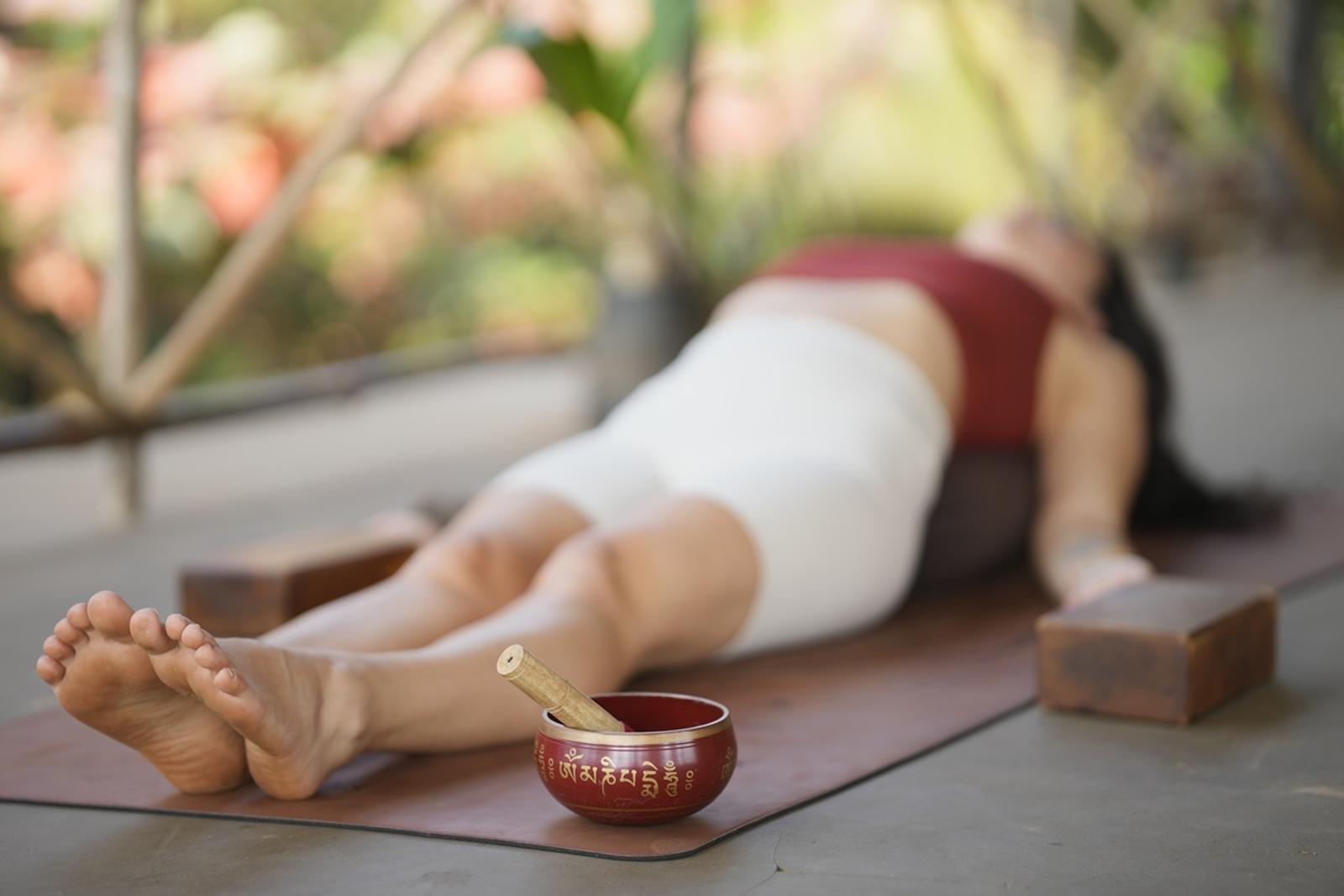
You lie on your back - on a mat, covered with a light sheet if needed, supported with bolsters if your back requires it. The teacher's voice begins with a rotation of consciousness: a systematic movement of awareness through the body, naming each part without effort or visualisation, simply touching it with attention. Most guests find this deeply strange the first time and deeply restful by the third or fourth session.
From there, the practice moves through different stages depending on the teacher and the traditional lineage being followed. At Nalanda, we use a classical approach rooted in the Bihar School tradition, which includes sankalpa (a short, quietly repeated intention), visualisation sequences, and a period of extended stillness before the practitioner is gently brought back.
The instruction throughout is the same: do nothing. If you fall asleep, that is fine - your body needed it. The practice has already done something whether you remained conscious through it or not.
On Sleep That Actually Restores
The sleep most people are getting is not the sleep the body needs.
This is not a controversial observation. Signs that your nervous system is running in survival mode - waking at 3am with racing thoughts, lying in bed exhausted but unable to switch off, mornings that require coffee before functioning is possible - are not signs of a busy schedule. They are signs that the autonomic nervous system is stuck in a pattern that normal sleep is not interrupting.
Yoga nidra, practised consistently and in a supportive environment, is one of the most reliably effective tools for beginning to shift that pattern. Not because it is a drug or a treatment, but because it gives the nervous system repeated, extended experience of a state it has forgotten how to reach on its own.
The guests who come to Nalanda specifically around sleep tend to leave with two things: measurably better sleep during their stay, and a practice they can take home. The home practice will not be identical to what happens at the retreat - the conditions are different - but it will work in a way it did not before, because the body now has a reference point for the state it is trying to reach.
The Morning After
Most guests who practise yoga nidra in the evening at Nalanda report waking without an alarm, earlier and more easily than they have in years. Not groggy. Present.
This is the specific quality of sleep that the practice supports - not longer, necessarily, but deeper. The architecture of the night shifts. REM sleep, where emotional processing happens, becomes more accessible. The grey-zone hours between midnight and 4am, where so many people cycle between anxiety and shallow sleep, begin to change.
If this sounds like something your body needs, it probably does.
Quick Answer: What is yoga nidra?
A guided meditation practice that induces a state between wakefulness and sleep - the brain's most restorative frequency. Practised lying down, typically lasting 30-60 minutes. Used clinically for anxiety, PTSD, and chronic insomnia. At a retreat, the surrounding environment significantly amplifies its effect.
Explore wellness and sleep programmes at https://nalandaretreat.com/programs or visit Soma Cove spa at https://nalandaretreat.com/soma-cove
Frequently asked questions
What is the difference between yoga nidra and regular meditation?
In regular seated meditation, you maintain wakefulness and observe the mind. Yoga nidra specifically targets the hypnagogic threshold - the edge of sleep - and is practised lying down. Falling asleep is not a failure; it is often part of the process.
How quickly does yoga nidra improve sleep?
Most guests notice an improvement within the first two to three sessions. The shift is often most noticeable after the third or fourth consecutive practice. Cumulative effect is significant; a week of daily practice at a retreat often produces changes that continue for weeks afterward.
Can I practise yoga nidra if I have insomnia?
Yes. Yoga nidra is one of the most widely used non-pharmaceutical interventions for chronic insomnia. It does not require you to be able to fall asleep on command - the practice works in the state before sleep, not in sleep itself.
Is yoga nidra the same as sleep hypnosis?
They share some characteristics - both use a guided voice, both access altered states of consciousness - but the mechanism and the tradition are different. Yoga nidra is not hypnosis; it does not introduce suggestions for behaviour change. It is a practice of conscious rest.
Do I need to know yoga to practise yoga nidra?
No. Yoga nidra requires no physical ability, no prior meditation experience, and no flexibility. You lie down and listen. That is the full extent of the physical requirement.
How does a retreat improve yoga nidra compared to practising at home?
The environment, the preceding day's structure, and the accumulated effect of multiple sessions in a short period all contribute. At home, you practise yoga nidra after a day of stimulation. At a retreat, the whole day is oriented toward reducing the load that the practice then works with. The difference is physiological, not psychological.