
" Important Notice: This article is written by the Nalanda Wellness Team for informational and educational purposes only. It does not constitute medical advice, diagnosis, or treatment. The Menopause Retreat is a structured wellness experience and is not a substitute for professional medical care or hormone replacement therapy (HRT) where medically indicated. All participants are strongly encouraged to consult a qualified healthcare provider - particularly a gynaecologist or endocrinologist - before attending any wellness programme during the menopause or perimenopause transition. Nalanda Retreat makes no medical claims regarding the reduction, or elimination of menopause symptoms."
The menopause transition is one of the most significant physiological shifts a woman's body undergoes. Hot flushes, sleep disruption, mood variability, joint discomfort, brain fog, and changes in skin and energy - these symptoms are real, common, and frequently under-addressed.
Conventional medicine has well-established approaches to menopause management, most notably hormone replacement therapy (HRT), which is highly effective for many women. Ayurveda offers a parallel and complementary framework - one that approaches the menopause transition not as a deficiency state to be corrected but as a constitutional shift that the body can be supported through.
The Menopause Retreat at Nalanda Retreat on Mandrem Beach, Goa, is designed for women navigating perimenopause and menopause who want a structured, practitioner-guided wellness experience alongside or in addition to conventional care.
Direct Answer
Nalanda's Menopause Retreat combines Ayurvedic constitutional assessment, targeted therapies for menopause-associated patterns (including Shirodhara, Ksheeradhara, and herbal support), daily yoga and meditation, and dietary guidance. All sessions are conducted by female practitioners. The retreat is a structured wellness programme and does not replace medical management. For current availability and programme details, contact the Nalanda team.
How Ayurveda Understands the Menopause Transition
Ayurveda places the menopause transition within the Vata phase of life - the later years when Vata (the air and space element, associated with movement, change, and dryness) naturally increases. The symptoms many women associate with menopause - hot flushes, dryness, sleep disruption, anxiety, joint changes - are understood in Ayurveda as expressions of elevated or imbalanced Vata and Pitta.
This framing does not pathologise menopause. It provides a lens through which specific symptoms can be addressed through constitutional approaches rather than blanket protocols.
The goal of an Ayurvedic approach to the menopause transition is not to eliminate the transition but to support the body through it with less friction - reducing the severity of specific patterns while building the general resilience that this phase of life asks for.
Pitta and the Hot Flush Pattern
Hot flushes and night sweats are commonly associated with elevated Pitta in the Ayurvedic framework. Cooling approaches - both dietary and therapeutic - are typically emphasised for women where this is a dominant pattern. Shirodhara with cooling oils, Ksheeradhara (milk-based streaming), and specific herbal preparations are often used in this context.
Vata and the Dryness, Sleep, and Anxiety Pattern
Dryness (skin, mucous membranes, joints), sleep disruption, and anxiety are associated with elevated Vata. Warm, nourishing oil-based approaches like Abhyanga, Kati Vasti, and specific Rasayana (rejuvenation) herbal preparations are used to support this pattern.
What the Menopause Retreat at Nalanda Involves
The Assessment
Every participant begins with an Ayurvedic Consultation with a female BAMS practitioner. This assessment maps your specific constitutional pattern and the symptoms that are most prominent for you. It also screens for any contraindications and identifies which approaches will be most useful for your particular presentation.
The Core Therapies
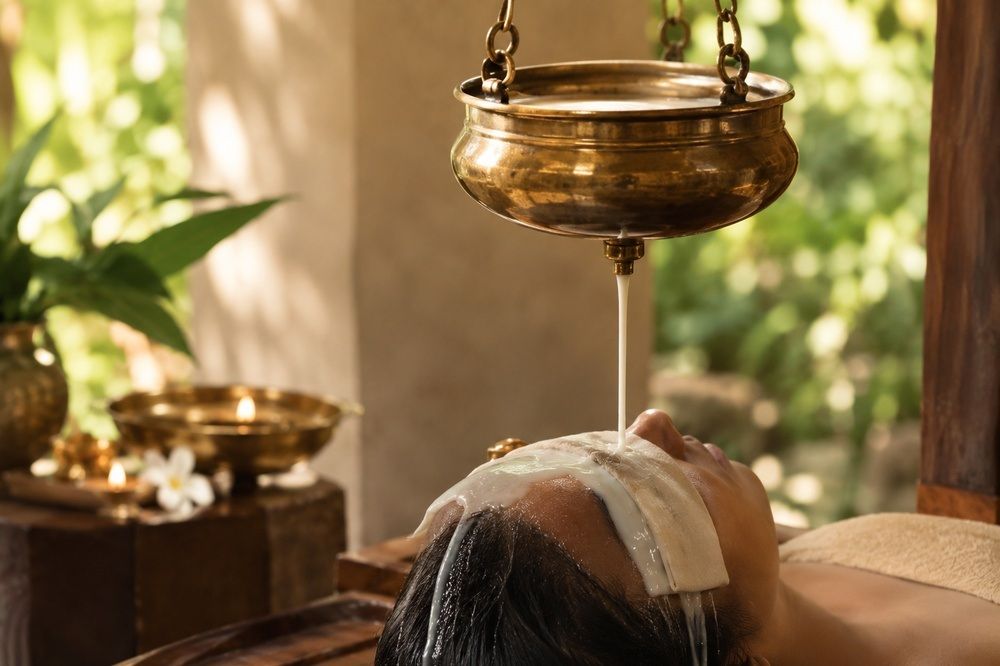
Shirodhara - a steady stream of warm oil over the forehead - is used specifically to support nervous system regulation and sleep quality. For women experiencing anxiety and sleep disruption during the menopause transition, it is one of the most consistently reported helpful approaches in this context.
Ksheeradhara (milk streaming) is a cooling variation of Shirodhara used specifically for Pitta-dominant presentations, particularly where hot flushes and heat-related symptoms are prominent.
Magnesium Soak supports the musculoskeletal system and the nervous system through transdermal magnesium absorption - relevant given the documented relationship between magnesium and sleep quality, muscle function, and mood.
Abhyanga with specific herbal oils selected for the Vata-Pitta pattern supports skin hydration, joint mobility, and the nervous system simultaneously.
Daily Yoga and Meditation
The yoga offered within the Menopause Retreat is specifically oriented toward this life stage - less emphasis on intense strength work, more emphasis on supportive, grounding practice that addresses joint mobility, pelvic floor health, and the nervous system. Yin Yoga, restorative practice, and Yoga Nidra are central elements.
All Sessions with Female Practitioners
All consultations and treatment sessions within the Menopause Retreat are conducted by female practitioners. View the Soma Cove specialist team.
Related Retreat Options at Nalanda
For women who want a broader hormonal health programme rather than a menopause-specific retreat, the Women's Hormonal Harmony programme addresses a wider range of hormonal patterns including perimenopause alongside PMS, hormonal skin and hair concerns, and related conditions.
The Hormonal Reset Retreat is a hosted retreat format with a focused schedule for hormonal health.
The Annual Women's Wellness Retreat is the broader women's health retreat offering with a wider focus.
Frequently asked questions
Is the Menopause Retreat suitable for women currently taking HRT?
Yes, in most cases. Ayurvedic approaches and HRT are not mutually exclusive. Some herbal preparations may interact with medications, which is why the pre-arrival health questionnaire and on-arrival assessment are important. Disclose all current medications when you enquire.
Is the retreat suitable for women in perimenopause rather than post-menopause?
Yes. The retreat is designed for the full menopause transition - from the early perimenopause stages through to post-menopause. The assessment on arrival determines which approaches are most appropriate for your current stage.
Can I attend this retreat if my primary concern is sleep disruption?
Yes. Sleep disruption is one of the most common menopause-associated patterns addressed in the retreat. Shirodhara and Yoga Nidra are specifically incorporated for this reason. You might also consider the Sleep Restoration programme if sleep is your primary concern rather than the broader menopause context.
How long should the retreat be?
A minimum of 5 nights is recommended. 7 nights allows for meaningful work across assessment, a full set of therapeutic approaches, and dietary adjustment. The benefits of Ayurvedic approaches for this life stage tend to be cumulative rather than immediate.
Are the practitioners female?
Yes. All consultations and treatment sessions within the Menopause Retreat are conducted by female practitioners. See the specialist team profiles.
What is the best time of year to attend?
The retreat runs year-round. October to March offers the most comfortable climate. The monsoon months (June to September) offer a quieter, more intimate environment at lower prices - some women find the post-monsoon freshness of October particularly good for this kind of reset.